
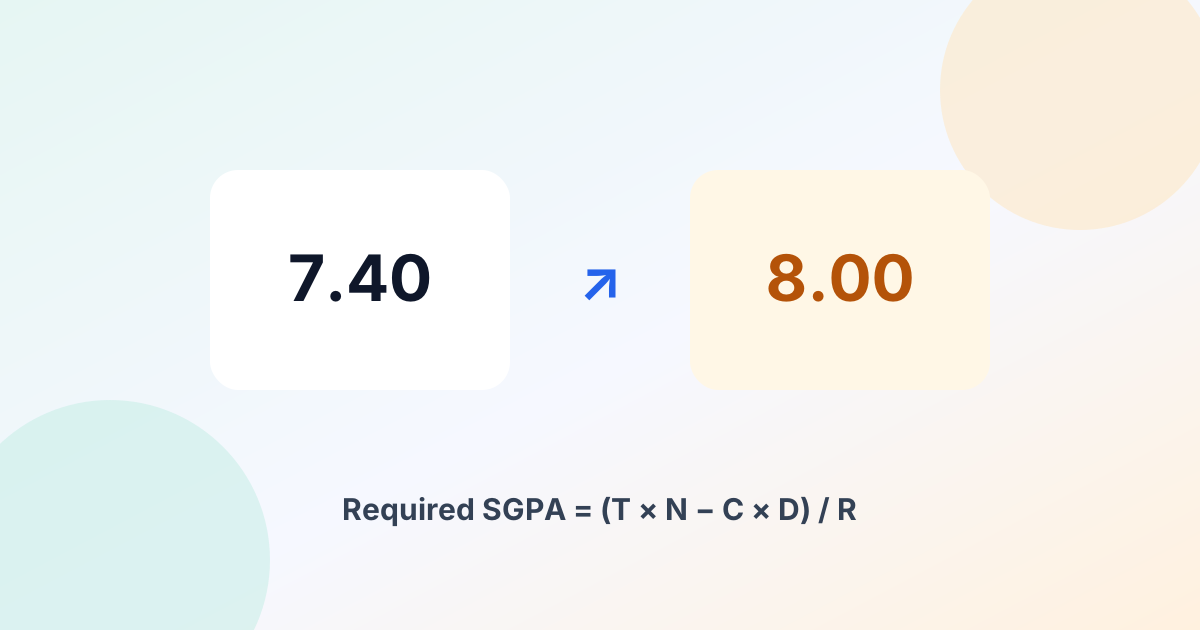
To improve your CGPA, you need an average SGPA above your current CGPA in the semesters that remain. How much it can rise depends on how many semesters you have already completed. Early in a degree a strong semester moves the CGPA a lot. In the final year, each semester carries less weight, so the same effort moves it less.
This guide starts with the math, so you can see what is realistic, then turns it into a plan.
How Much Can Your CGPA Still Move?
CGPA is a weighted average of all semesters. Every completed semester is locked in, and only the remaining ones can change the result.
| Semesters done (of 8) | Current CGPA | Best possible final CGPA (all 10s) |
|---|---|---|
| 2 | 7.0 | 9.25 |
| 4 | 7.0 | 8.50 |
| 6 | 7.0 | 7.75 |
| 7 | 7.0 | 7.38 |
The table assumes equal credits each semester. After six semesters, even perfect scores lift a 7.0 to only 7.75. That is why the earlier you start, the more room you have.
The Formula for the SGPA You Need
Required SGPA = (Target x Total semesters - Current CGPA x Semesters done) / Semesters remaining
Example: CGPA 7.40 after 4 of 8 semesters, target 8.00.
Required SGPA = (8.00 x 8 - 7.40 x 4) / 4 = (64.0 - 29.6) / 4 = 8.60
So you need to average 8.60 in each of the last four semesters. The Target CGPA Calculator does this instantly, and switches to credits when your semesters carry different loads.
A Practical Plan
1. Clear any backlog first
A failed subject usually counts as 0 grade points with its credits still in the total. Clearing it can lift your CGPA more than any single good grade, and an active backlog can block placements regardless of CGPA.
2. Rank subjects by credits
A one-grade improvement in a 4-credit subject is worth four times as much as the same improvement in a 1-credit lab. List next semester's subjects by credits and give the heaviest ones the most preparation time.
3. Secure internal marks early
Internal assessment, assignments, and lab records are often a large share of the final grade and are the most predictable part. Losing them makes the end-semester exam carry more than it should.
4. Aim for the next grade band, not a perfect score
Grades are bands. Moving from just below an A to an A gains a full grade point. Find out the mark range for each grade at your university and target the nearest band boundary in each subject.
5. Use labs and projects
Practical subjects and projects often have higher average grades. Do not treat them as low priority just because they carry fewer credits.
6. Recalculate after each result
After every semester, enter the new SGPA in the SGPA to CGPA Calculator and recheck your target. The required SGPA changes every time.
When the Target Is Out of Reach
If the calculator says even perfect scores cannot reach the target, change the goal, not your expectations of yourself. Check whether your university allows grade improvement exams and how they are recorded, and put more weight on what else you bring: projects, internships, and test scores. See What Is a Good CGPA? for how cut-offs are usually applied.
FAQs
Can I increase my CGPA in the last semester?
Yes, but only a little, because one semester is a small share of the total. Use the calculator to see the exact effect.
Does a re-exam replace the failed grade?
It depends on the regulations. Some universities replace the grade, some cap it, and some show both attempts. Check your program's rules.
Is it better to improve SGPA or clear backlogs?
Clear backlogs first. They hurt the CGPA and can disqualify you from opportunities on their own.