
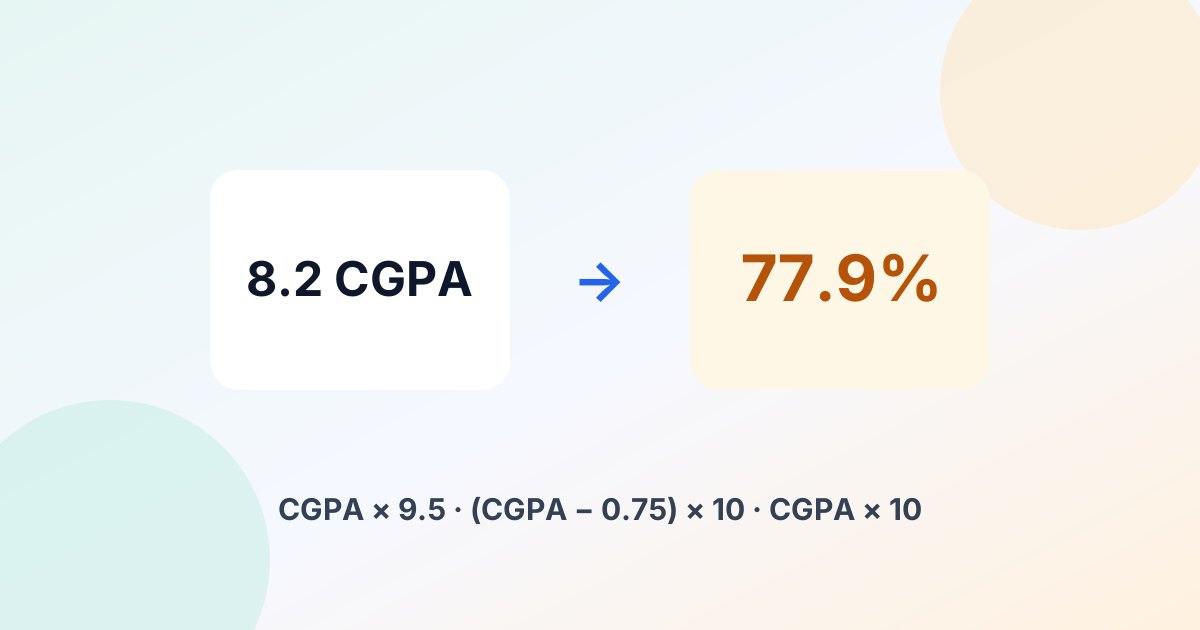
There is no single CGPA to percentage formula. The three you will meet most often are CGPA x 9.5, (CGPA - 0.75) x 10, and CGPA x 10, and the right one is whichever your own university publishes. The same 8.0 CGPA becomes 76%, 72.5%, or 80% depending on the rule, so picking the wrong one can change whether you clear a cut-off.
This guide explains where each formula comes from, shows a worked example for each, and walks through how to find the official rule for your degree.
Why One CGPA Gives Different Percentages
A CGPA is an average of grade points, not marks. Grade points are bands: on a 10-point scale an "A" might cover every mark from 70 to 79. Once marks are turned into bands, the exact percentage is gone, so any conversion back to a percentage is an estimate built on an assumption about where students sit inside each band.
Each university makes its own assumption and publishes a formula that matches its grading bands. That is why the formula belongs to the institution, not to the CGPA.
Formula 1: Percentage = CGPA x 9.5
This is the best-known rule. CBSE introduced it for its 10-point CGPA in school results, based on the average performance of students across subjects, and many colleges later adopted the same multiplier.
Example: a CGPA of 8.2 gives 8.2 x 9.5 = 77.9%.
Use it only if your university or board names it. It is also the default many employers assume when a form says "multiply by 9.5", but that is a convention, not a law.
Formula 2: Percentage = (CGPA - 0.75) x 10
Several technical universities use this rule, including Visvesvaraya Technological University (VTU) for its CBCS schemes. Subtracting 0.75 before multiplying reflects that marks inside each grade band are, on average, a little lower than the top of the band.
Example: a CGPA of 8.2 gives (8.2 - 0.75) x 10 = 7.45 x 10 = 74.5%.
Formula 3: Percentage = CGPA x 10
Some universities, including Anna University, simply multiply by 10. It is the easiest rule and gives the highest percentage of the three for the same CGPA.
Example: a CGPA of 8.2 gives 8.2 x 10 = 82%.
Side-by-Side Comparison
| CGPA | x 9.5 | (CGPA - 0.75) x 10 | x 10 |
|---|---|---|---|
| 6.0 | 57.0% | 52.5% | 60.0% |
| 6.5 | 61.75% | 57.5% | 65.0% |
| 7.0 | 66.5% | 62.5% | 70.0% |
| 7.5 | 71.25% | 67.5% | 75.0% |
| 8.0 | 76.0% | 72.5% | 80.0% |
| 8.5 | 80.75% | 77.5% | 85.0% |
| 9.0 | 85.5% | 82.5% | 90.0% |
| 9.5 | 90.25% | 87.5% | 95.0% |
Look at the 60% line many job and exam forms use. A 6.5 CGPA clears it under CGPA x 9.5 and CGPA x 10 but not under (CGPA - 0.75) x 10. If you are close to a cut-off, the formula matters more than the CGPA.
How to Find Your University's Official Formula
Work through these sources in order. Stop at the first one that gives a formula:
- The back of your grade card or consolidated marksheet. Many universities print the conversion rule in the legend.
- Your program's academic regulations. Search the PDF for "percentage" or "equivalence".
- A circular or notification from the examination section. Universities often publish the rule as a standalone notice.
- A conversion certificate. If a recruiter or university abroad asks for a percentage, your university can usually issue an official letter stating it.
If none of these exists, write the CGPA on its own scale (for example, "CGPA 8.2 / 10") instead of inventing a percentage.
What About SGPA?
The same formulas are usually applied to SGPA when a form asks for a semester percentage. The caveat is the same: use the one your university names. Our SGPA Calculator shows the x 9.5 estimate next to your SGPA as a quick reference.
Common Mistakes
- Using x 9.5 because "everyone does". It is common, not universal.
- Converting each semester and averaging the percentages. Convert the final CGPA once, after the credit-weighted average, unless your regulations say otherwise.
- Rounding too early. Keep two decimals in the CGPA and round only the final percentage.
- Mixing scales. These formulas are for 10-point CGPA only. A 4.0 GPA needs a different method, explained in How to Convert GPA Into Percentage.
FAQs
Is CGPA x 9.5 accepted everywhere?
No. It is the most widely recognised rule in India, but universities that publish their own formula expect you to use theirs.
Which formula should I use on a job application?
Use your university's official formula. If the form names a specific formula, use that one and mention it, for example "76% (CGPA x 9.5)".
Can I convert percentage back to CGPA?
Yes, by reversing the same formula: CGPA = percentage / 9.5, CGPA = percentage / 10 + 0.75, or CGPA = percentage / 10.