
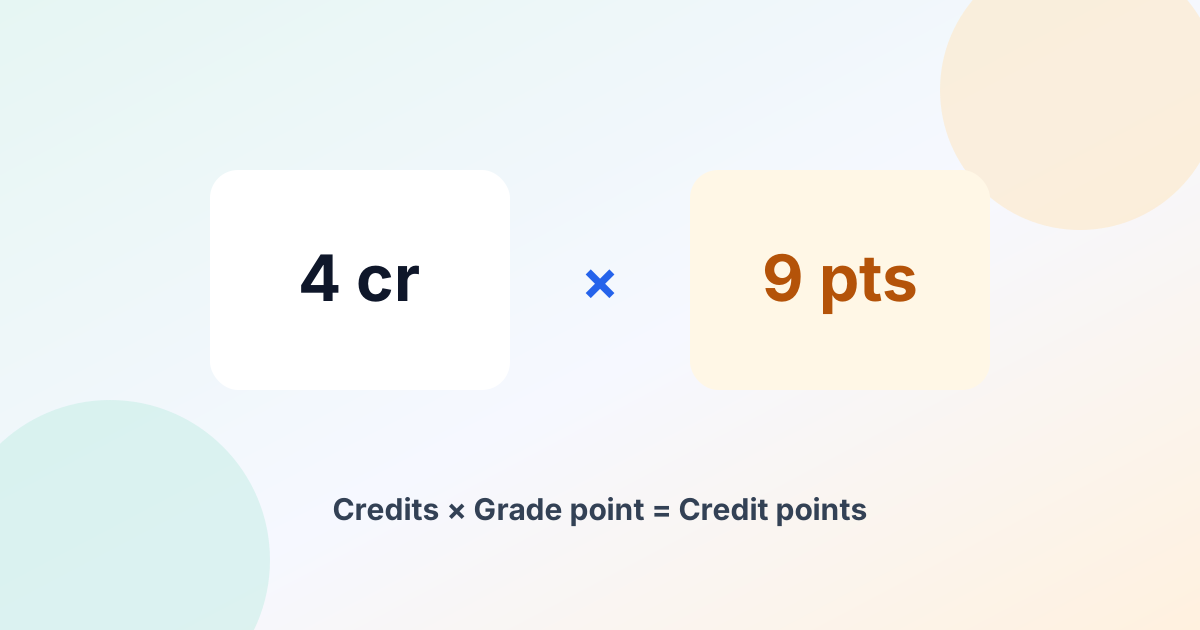
A credit measures how much teaching and study time a subject involves. In your SGPA and CGPA, credits act as weights: a 4-credit subject counts four times as much as a 1-credit subject. Understanding credits explains why two students with the same grades can end up with different SGPAs.
What Is a Credit?
Under the UGC Choice Based Credit System used by many Indian universities, one credit typically means:
- one hour of lecture or tutorial per week across the semester, or
- two hours of practical or lab work per week across the semester.
So a theory subject with three lectures and one tutorial each week is usually 4 credits, while a weekly two-hour lab is 1 credit. The exact mapping is set by each university's syllabus.
Other systems use the same idea with different units. In the US, a credit hour is roughly one hour of class per week over a semester. In Europe, ECTS credits measure total student workload, as explained in ECTS Credits Explained.
Credits, Grade Points, and Credit Points
These three terms appear on most grade cards:
| Term | What it means | Example |
|---|---|---|
| Credits | Weight of the subject | 4 |
| Grade point | Value of the grade you earned | A+ = 9 |
| Credit points | Credits x grade point | 4 x 9 = 36 |
Your SGPA is total credit points divided by total credits.
Why Credits Change the Result
Two students both get grades of 10, 8, and 6 in three subjects. The only difference is which subject carries the most credits.
| Subject | Credits | Student A grade | Student B grade |
|---|---|---|---|
| Core theory | 4 | 10 | 6 |
| Elective | 3 | 8 | 8 |
| Lab | 1 | 6 | 10 |
- Student A: (40 + 24 + 6) / 8 = 8.75
- Student B: (24 + 24 + 10) / 8 = 7.25
Same three grades, a 1.5-point difference in SGPA. A simple average would have given both students 8.00, which is why credit-weighted averaging is the standard method. Try your own numbers in the SGPA Calculator.
Credits Across Semesters
The same logic applies when SGPAs are combined into CGPA. A semester with 26 credits pulls the CGPA more than one with 18. If your semesters carry different totals, use the credit-based method in the SGPA to CGPA Calculator, not the simple average.
Earned vs Registered Credits
- Registered credits are all the credits you took in a semester.
- Earned credits are the credits for subjects you passed.
Most CBCS regulations divide by registered credits when calculating SGPA, so a failed subject still counts in the denominator. Your degree is awarded when the earned credits reach the program requirement.
FAQs
How many credits is a typical semester?
In Indian undergraduate programs, commonly 18 to 26 credits, depending on the program and semester.
Do non-credit or audit courses count in SGPA?
Usually not. Mandatory non-credit courses must be passed but carry no credits, so they do not affect the average.
Why does my SGPA differ from a simple average of my grades?
Because SGPA weights each grade by credits. The difference is largest when your strongest or weakest grade is in a high-credit subject.