
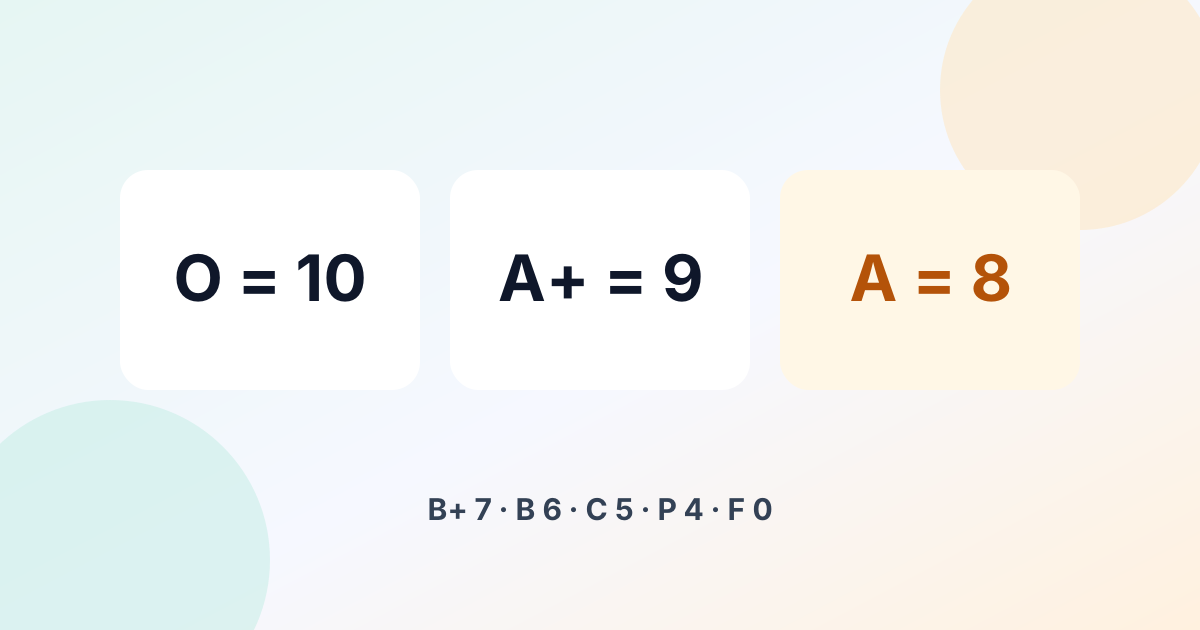
In the 10-point grading system each letter grade carries a grade point from 10 down to 0: O = 10, A+ = 9, A = 8, B+ = 7, B = 6, C = 5, P = 4, and F = 0. Your SGPA is the credit-weighted average of these grade points, and your CGPA is the credit-weighted average of your SGPAs.
The Standard Grade Table
The UGC guidelines for the Choice Based Credit System recommend this scale, and most Indian universities follow it or something close to it.
| Letter grade | Meaning | Grade point |
|---|---|---|
| O | Outstanding | 10 |
| A+ | Excellent | 9 |
| A | Very Good | 8 |
| B+ | Good | 7 |
| B | Above Average | 6 |
| C | Average | 5 |
| P | Pass | 4 |
| F | Fail | 0 |
| Ab | Absent | 0 |
Some universities use different letters (for example S, A, B, C, D, E, F) or slightly different points. The legend on your grade card is the final word.
How Marks Turn Into Grades
There are two common methods.
Absolute grading
Fixed mark ranges map to each grade. A common pattern is 90 to 100 for O, 80 to 89 for A+, 70 to 79 for A, and so on down to the pass mark. Everyone who scores in a range gets that grade, regardless of how the class performed.
Relative grading
Grades depend on your position in the class. The university looks at the distribution of marks, often using the class average and spread, and sets the band boundaries from that. The same 72 marks can be an A in a hard paper and a B+ in an easy one.
Your regulations say which method applies. Many programs use relative grading for large theory papers and absolute grading for labs and projects.
From Grades to SGPA
Each grade point is multiplied by the subject's credits, the results are added, and the total is divided by total credits:
SGPA = Sum(Credits x Grade point) / Sum(Credits)
Example: O (10) in a 3-credit subject, A (8) in a 4-credit subject, and B+ (7) in a 2-credit subject give (30 + 32 + 14) / 9 = 8.44.
The SGPA Calculator has these letter grades built in, so you can pick them from a list.
What the Pass Grade Means
P (4 grade points) is the lowest passing grade. An F carries no grade points, but in most regulations its credits still count in the semester total until you clear the subject. That is the main reason one failed paper can pull an SGPA down sharply; How Backlogs and Failed Subjects Affect SGPA and CGPA covers this in detail.
How It Compares With Other Scales
| System | Top grade | Typical pass | Notes |
|---|---|---|---|
| Indian 10-point | O = 10 | P = 4 | Credit-weighted SGPA and CGPA |
| US 4.0 | A = 4.0 | D = 1.0 | Letter grades with plus and minus steps |
| German 1.0 to 5.0 | 1.0 | 4.0 | Lower is better; see the German Grade Calculator |
Converting between these systems needs care, because the bands do not line up neatly. Use the official rule where one exists.
FAQs
What does "O" grade mean?
O stands for Outstanding and carries the maximum 10 grade points.
Is A+ better than A?
Yes. A+ is 9 grade points and A is 8.
Can my SGPA be 10?
Yes, if you earn O in every subject of the semester.