
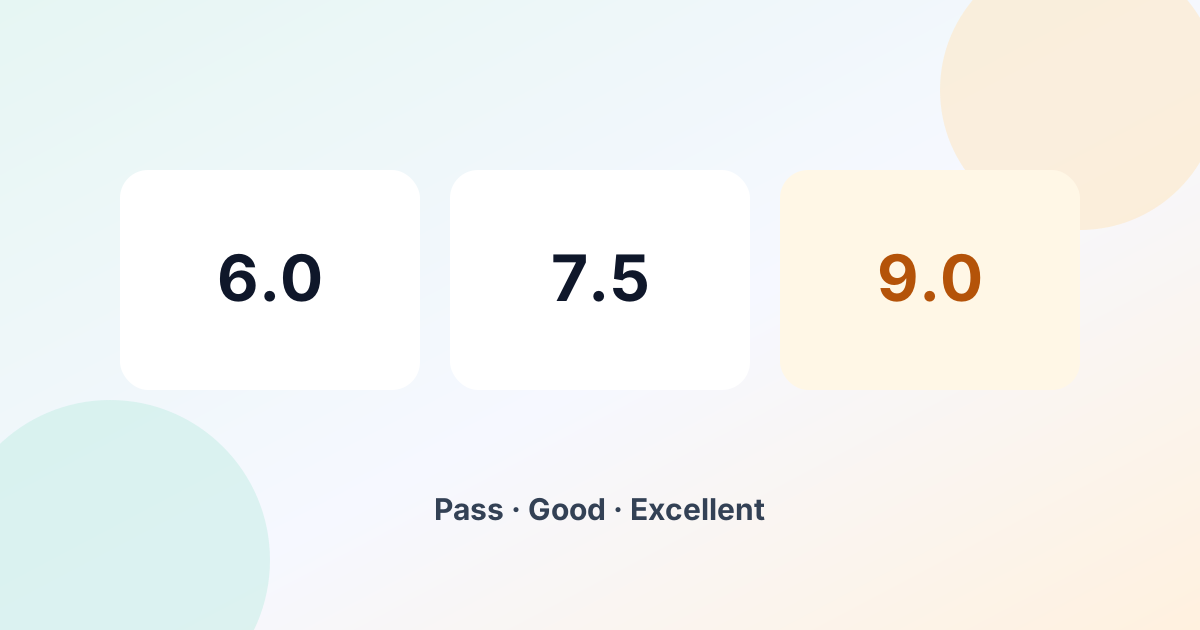
On a 10-point scale, a CGPA of 7.5 or above is generally seen as good, 8.5 or above as very good, and 9.0 or above as excellent. But "good" only means something next to a specific goal. A 7.0 clears most campus placement filters, while a competitive master's program abroad may expect 8.0 or more.
This guide gives realistic ranges, explains where common cut-offs come from, and shows what to do when your CGPA is close to one.
How CGPA Bands Are Usually Read
| CGPA (10-point) | How it is usually read | Rough percentage (x 9.5) |
|---|---|---|
| 9.0 and above | Excellent, top of the class | 85.5% and above |
| 8.0 to 8.9 | Very good | 76% to 84.6% |
| 7.0 to 7.9 | Good, clears most filters | 66.5% to 75% |
| 6.0 to 6.9 | Average, meets minimums | 57% to 65.6% |
| Below 6.0 | Below many cut-offs | Below 57% |
The percentage column uses the CGPA x 9.5 rule only as an example. Your university may use a different one; see CGPA to Percentage: Which Formula Does Your University Use?.
Common Cut-offs You Will Meet
These are typical patterns, not fixed rules. Always read the actual notice.
- Campus placements: many recruiters filter at 6.0, 6.5, or 7.0 CGPA, sometimes with "no active backlogs" added.
- Postgraduate entrance in India: programs often ask for a minimum of 50% to 60% aggregate or an equivalent CGPA in the qualifying degree.
- Master's abroad: universities state minimum grades for each country. Highly selective programs often expect the equivalent of a strong first class, which is commonly 7.5 to 8.0 or higher on a 10-point scale.
- Scholarships: merit scholarships tend to sit at the top end, often 8.0 or more.
Why the Same CGPA Can Mean Different Things
Grading is not uniform. A 7.5 in a program where the class average is 6.8 says more than a 7.5 where the average is 8.2. Admissions teams that see many applicants from one university learn this context, and some ask for your class rank or a grade distribution to read your CGPA fairly.
Your trend also matters. A CGPA that climbs from 6.8 to 7.6 over four years tells a better story than one that falls from 8.4 to 7.6.
If Your CGPA Is Below a Cut-off
- Check how far you are and how much time is left. The Target CGPA Calculator shows the SGPA you need in each remaining semester and the highest CGPA you can still reach.
- Clear backlogs first. An active backlog can disqualify you even when the CGPA is fine. See How Backlogs and Failed Subjects Affect SGPA and CGPA.
- Build evidence beyond grades. Projects, internships, publications, and strong entrance or language test scores can offset a borderline CGPA where the cut-off is not strict.
- Use the right conversion. If a form asks for a percentage, the official formula may put you above the line where another formula would not.
FAQs
Is 7 CGPA good?
Yes for most purposes. It clears the majority of placement filters and many postgraduate minimums, though very competitive programs may expect more.
Is 8 CGPA good for a master's abroad?
Generally yes. It is a strong result on most Indian 10-point scales, but check the specific program's stated minimum for your country.
Does CGPA matter after the first job?
Less and less. After a few years, work experience usually carries more weight, although some employers and government roles still ask for it.