
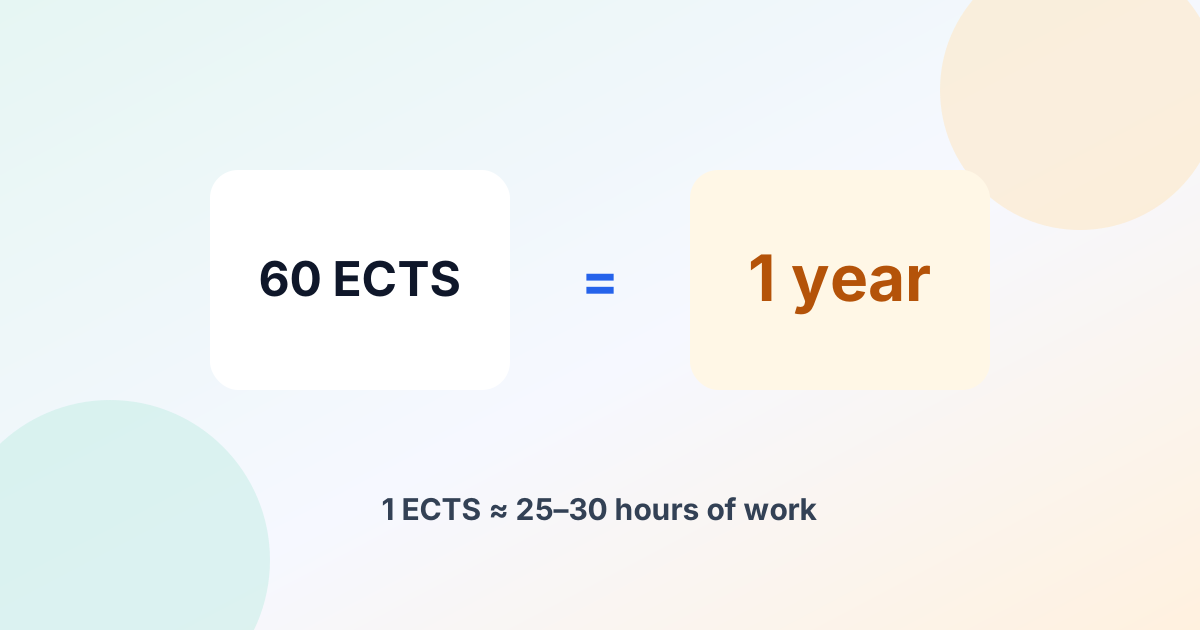
ECTS (European Credit Transfer and Accumulation System) credits measure total student workload. One full-time academic year is 60 ECTS, and one ECTS credit stands for about 25 to 30 hours of study, including lectures, self-study, assignments, and exams. A three-year bachelor's is usually 180 ECTS and a four-year bachelor's is usually 240 ECTS.
How ECTS Differs From Indian Credits
Indian CBCS credits are based mainly on contact hours: one credit is typically one hour of lecture per week, or two hours of lab, across a semester. ECTS counts all the work a typical student needs, including hours outside class.
| Indian CBCS credit | ECTS credit | US credit hour | |
|---|---|---|---|
| Based on | Weekly contact hours | Total workload | Weekly class hours |
| Typical year | About 40 to 50 credits | 60 ECTS | About 30 credits |
| One unit roughly equals | 1 lecture hour per week per semester | 25 to 30 hours of total work | 1 class hour per week per semester |
Because the units measure different things, there is no exact universal conversion. Universities that need one, such as for admission to a German master's program, compare your whole program length and content, not a formula.
Do I Need to Convert My Credits?
Usually not by yourself. When you apply:
- Your transcript shows credits in your own system. Submit it as issued.
- Some applications ask how many ECTS your degree is worth. A common approach is to equate one full academic year with 60 ECTS, so a four-year degree is treated as 240 ECTS, but follow the instructions the university gives.
- Admissions offices or evaluators (for example uni-assist for many German universities) decide the equivalence.
How Your CGPA Is Read in Europe
European universities do not average credits differently, but they do convert grades. Germany is the clearest example: grades are converted to the German 1.0 (best) to 5.0 (fail) scale with the Modified Bavarian Formula:
German grade = 1 + 3 x (Best grade - Your grade) / (Best grade - Minimum pass grade)
Example: CGPA 8.2 on a 10-point scale where 4.0 is the minimum pass: 1 + 3 x (10 - 8.2) / (10 - 4) = 1 + 0.9 = 1.9.
The minimum passing grade matters a lot, so use the one printed on your grade card. The German Grade Calculator runs this formula for percentages, 10-point CGPA, and 4.0 GPA.
Practical Checklist for Applicants
- Get your consolidated transcript showing credits and grades for every subject.
- Find the grading legend, including the minimum pass grade.
- Note your total program length in years and credits.
- Check the target university's stated method for credits and grades before converting anything yourself.
- Keep your CGPA in its original form on forms unless a converted figure is specifically requested.
FAQs
How many ECTS is a 4-year Indian bachelor's degree?
It is commonly treated as 240 ECTS, one year being 60 ECTS, but the receiving university makes the final decision.
Is 1 Indian credit equal to 1 ECTS?
No. They measure different things: contact hours versus total workload.
Does a higher number of credits improve my application?
Not by itself. Universities look at whether your degree covers the required subject areas and level, and at your grades.