
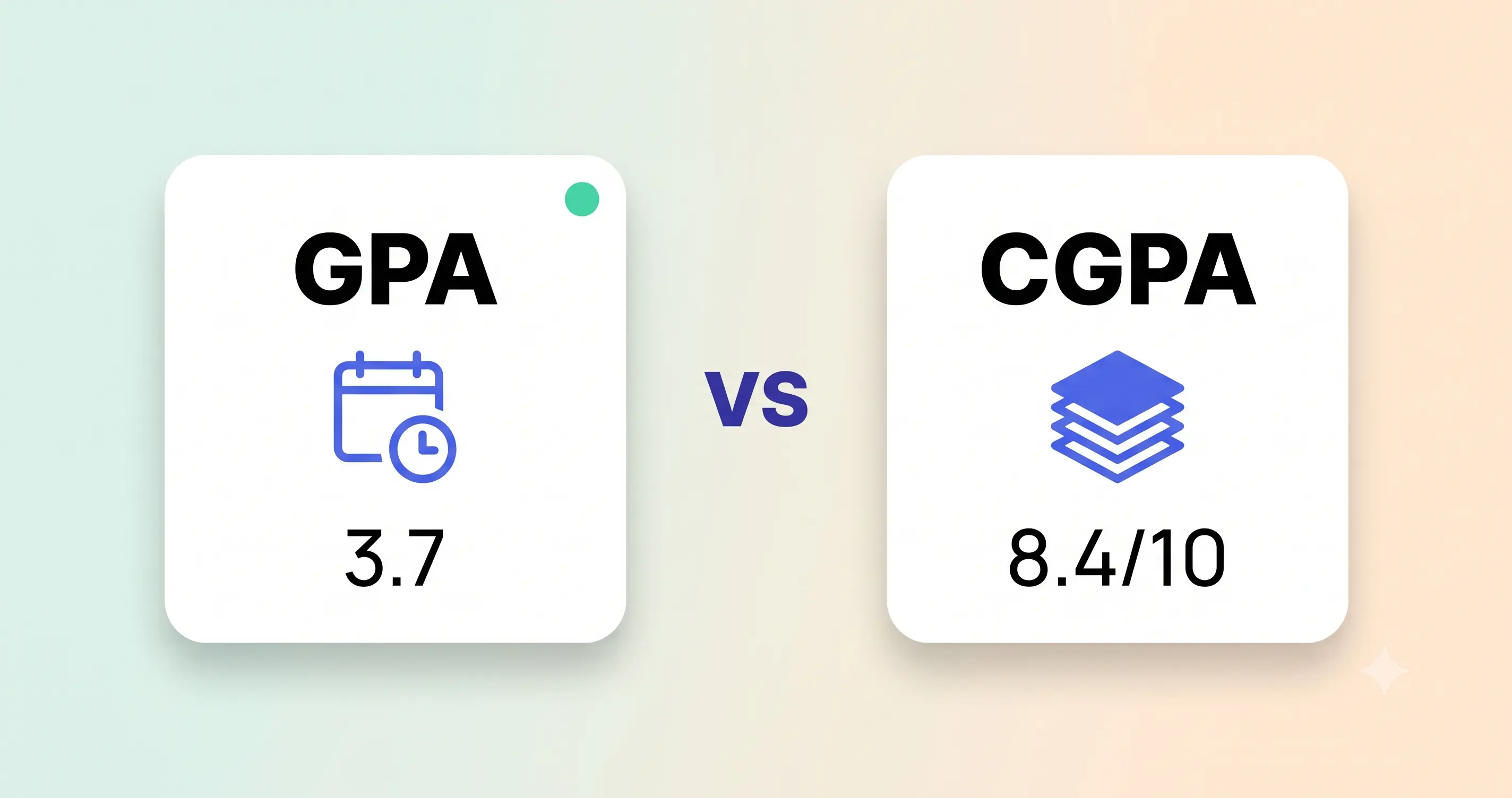
Grade Point Average (GPA) measures one semester or term, while Cumulative Grade Point Average (CGPA) measures academic performance across multiple semesters or the full program. That is the main difference between GPA and CGPA.
Knowing the difference matters for 4 common places: college applications, scholarship forms, resumes, and study-abroad profiles. Your academic record can look wrong when a form asks for CGPA and you enter only one semester GPA. The score can also mismatch the required grading system when a form asks for GPA on a 4.0 scale and you enter a 10-point CGPA.
The guide explains GPA meaning, CGPA meaning, calculation methods, conversion rules, and the score that matters most in different countries.
What Is GPA?
GPA means Grade Point Average. GPA measures academic performance for a fixed period, such as one semester, one term, or one year.
A GPA is calculated from the grade points earned in courses during that period. Each letter grade or numeric grade is converted into grade points. Larger courses carry more weight if credit hours are used.
For example, a student who takes four courses in one semester can earn a semester GPA of 3.6 on a 4.0 scale. That GPA reflects only that semester, not the full degree.
For "what is GPA and CGPA," GPA is the term score.
What Is CGPA?
CGPA means Cumulative Grade Point Average. CGPA measures academic performance across multiple semesters or the full program.
A CGPA combines semester results into one cumulative average. CGPA can use semester GPAs, total grade points, total credit hours, or a university-specific formula. The method depends on the grading system used by the school or university.
For example, a student who completes four semesters with GPAs of 3.4, 3.6, 3.5, and 3.7 has one combined CGPA for all four terms. Use completed credits and new course grades to update your cumulative GPA after a new term.
CGPA appears on transcripts, degree records, job applications, and placement forms. In India, many universities use a 10-point scale for CGPA.
GPA vs CGPA: The Core Difference
The core difference is time. GPA measures one term. CGPA measures the full academic record up to that point.
No. GPA and CGPA are related, but GPA and CGPA are not the same. GPA can become part of CGPA, but CGPA covers more than one semester.
| Factor | GPA | CGPA |
|---|---|---|
| Full form | Grade Point Average | Cumulative Grade Point Average |
| Scope | One semester, term, or year | Multiple semesters or full program |
| Time period | Short-term performance | Long-term academic average |
| Scale used | Often 4.0, 5.0, 7.0, or 10-point scale | Often same scale as the university system |
| Purpose | Track term performance | Show total academic standing |
| Who uses it | Schools, colleges, admissions teams | Universities, employers, transcript evaluators |
No. CGPA and GPA are not the same. GPA is term-based. CGPA is cumulative.
How GPA Is Calculated
GPA is calculated with grade points and credit hours.
GPA = Total quality points / Total credit hours
To find quality points, multiply grade points by credit hours.
| Course | Grade Point | Credit Hours | Quality Points |
|---|---|---|---|
| Math | 4.0 | 3 | 12.0 |
| English | 3.0 | 3 | 9.0 |
| Science | 3.7 | 4 | 14.8 |
| History | 3.3 | 2 | 6.6 |
Total quality points = 42.4
Total credit hours = 12
GPA = 42.4 / 12 = 3.53
The calculated GPA shows the student's performance for that semester only. You can calculate your final grade separately when you are planning around an exam score instead of past course grades.
How CGPA Is Calculated
CGPA can be calculated in 2 common ways.
The simple method averages all semester GPAs:
CGPA = Sum of semester GPAs / Number of semesters
Example:
Semester GPAs: 3.4, 3.6, 3.5, 3.7
CGPA = (3.4 + 3.6 + 3.5 + 3.7) / 4 = 3.55
The credit-based method uses total grade points and total credit hours across all terms:
CGPA = Total grade points from all semesters / Total credit hours from all semesters
The credit-based method is more accurate when semesters have different credit loads. A 24-credit semester affects CGPA more than a 12-credit semester.
How to Convert GPA to CGPA (and Back)
To convert GPA to CGPA, combine multiple semester GPAs on the same scale. The exact method depends on credit hours and grading rules.
Calculate CGPA by combining multiple GPAs when GPA and CGPA use the same scale.
How to calculate CGPA from GPA
To calculate CGPA from equal-weight semesters, add the semester GPAs and divide by the number of semesters.
CGPA = Sum of semester GPAs / Number of semesters
Example:
GPA values: 8.0, 8.4, 7.8, 8.2
CGPA = 32.4 / 4 = 8.10
To calculate CGPA from different-credit semesters, multiply each GPA by semester credits, add the weighted results, and divide by total semester credits.
CGPA = Sum(GPA x semester credits) / Total semester credits
Use the main calculator to convert your Semester Grade Point Average (SGPA) to CGPA when your semesters are listed as SGPA values.
How to convert CGPA to GPA
To convert a 10-point CGPA to a 4.0 GPA estimate, many tools use CGPA divided by 10, then multiplied by 4.
4.0 GPA = (CGPA / 10) x 4
Example:
8.5 CGPA = (8.5 / 10) x 4 = 3.40 GPA
For how to convert 10 CGPA to 4 GPA:
10 CGPA = (10 / 10) x 4 = 4.00 GPA
For Indian CGPA to American GPA, use the rule required by the university, World Education Services (WES), or application portal. A rough formula helps for planning, but official evaluation can differ.
GPA and CGPA Around the World
GPA and CGPA scales change by country, so the same number can mean different academic standing.
United States (US): Most schools and universities use a 4.0 scale. Letter grades, such as A, B, C, and D, convert into grade points.
Canada: Many institutions use a 4.0 scale, but some use 4.3, 9.0, or percentage systems.
India: Many universities use a 10-point scale for CGPA. University Grants Commission (UGC)-linked institutions often report semester SGPA and cumulative CGPA.
Australia: Many universities use a 7.0 scale, where 7 usually represents the highest grade band.
United Kingdom (UK): The UK often uses percentages and degree classifications, such as First Class, Upper Second, and Lower Second.
Germany: The German grading scale is inverted from 1.0 to 5.0, where 1.0 is the best score and 4.0 is usually the lowest passing grade.
Use 4 source documents for official reporting: transcript guide, university handbook, admissions form, and WES evaluation instructions. For transcripts, admissions, scholarships, and WES evaluations, always match the required scale.
Which One Matters More?
CGPA usually matters more for total academic standing, while GPA usually matters more for term performance or converted-scale applications.
For Indian campus placements, CGPA often matters more. Employers can set a minimum CGPA cutoff, such as 6.5, 7.0, or 8.0 out of 10. Employers want the full academic record, not one strong semester.
For study-abroad applications, converted GPA often matters more. US and Canadian universities can ask for a 4.0 GPA equivalent. UK and Australian universities can ask for percentages, degree classification, or their own converted score.
For scholarships, both can matter. Some forms ask for cumulative academic performance, while others require the most recent term GPA.
Use CGPA for total academic standing. Use GPA for a term score or converted scale.
FAQs
Is GPA and CGPA the same thing?
No. GPA measures one semester or academic term. CGPA measures cumulative academic performance across multiple semesters.
What is the difference between CGPA and GPA in one sentence?
GPA is the grade point average for one term; CGPA is the cumulative grade point average across many terms.
How do I convert my GPA to CGPA?
Add all semester GPAs and divide by the number of semesters if each semester has equal weight. Multiply each GPA by semester credits, add the results, and divide by total credits if credit hours differ.
How do I convert my CGPA to GPA?
Use GPA = (CGPA / 10) x 4 for a rough 10-point to 4.0 estimate. For official admissions, use the formula required by the university or evaluation service.
How do I convert CGPA or GPA to percentage?
Use the formula required by your university or application form. You can convert to percentage with a reference formula such as GPA divided by scale multiplied by 100 if no official rule is given.
Which scale do US universities use?
Most US universities use a 4.0 GPA scale. Some application systems ask international students to report the original CGPA and convert the score through WES or an admissions review.
Conclusion
The difference between GPA and CGPA is simple: GPA is usually a semester or term score, while CGPA is cumulative. GPA helps you see how one academic term went. CGPA shows your broader academic record across semesters.
Use GPA for term performance, course planning, and 4.0-scale applications. Use CGPA for transcripts, placements, and cumulative academic standing. When converting between GPA and CGPA, always check the scale and credit-hour method before reporting the number.